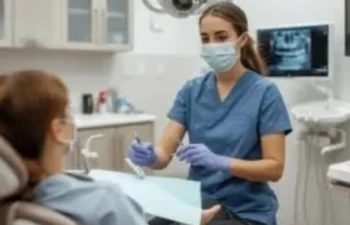
Ask someone what a dental hygienist does and you’ll usually get “cleans teeth.” That’s true, but the actual responsibilities of a dental hygienist go a lot further: reviewing health history, screening for gum disease and oral cancer, taking X rays, applying preventive treatments, writing up notes the dentist depends on, and talking with patients more than almost anyone else in the building. How much of that actually happens during your appointment depends heavily on the office.
Before anyone picks up a scaler
The visit starts with the chart, not the chair. A hygienist checks what happened last time, asks about anything new, medications, health changes, a concern the patient brings up on their own. Miss this step and you can miss something that reshapes the whole appointment. Maybe there’s a blood thinner that calls for extra care. Maybe a new diagnosis changes which X rays make sense that day.
The cleaning
Yes, this is still central to the job, and it’s harder than it looks. Scrape too hard and you damage enamel or aggravate the gums. Too light and the tartar just sits there. Beyond removing buildup with hand tools and an ultrasonic scaler, hygienists polish away surface stains, floss between every tooth, and apply fluoride or sealants, particularly useful for kids whose enamel is still developing.
Screening: where it stops being routine
This part is where the job turns into real diagnostic work rather than maintenance. Using a periodontal probe, a hygienist measures gum pocket depth around each tooth, catching early gum disease long before a patient notices anything wrong. They check the jaw, neck, and head for swelling or anything off. Plenty also run oral cancer screenings as a standard part of the visit, checking the tongue, cheeks, and throat. Since hygienists spend more hands-on time in a patient’s mouth than the dentist usually does, they’re often the first to flag something worth a closer look.
Taking X rays
Sounds mechanical. Isn’t, really. A hygienist decides between a bitewing for a close look at specific teeth and a panoramic shot for the full jaw, positions the patient, follows radiation safety steps the whole time. The dentist reads the images afterward, but what gets captured, and how often, comes down to calls the hygienist makes in the room.
Teaching patients something they’ll actually use
A cleaning handle today. Education is supposed to stop the next visit from being worse. A real chunk of the appointment goes to walking through brushing and flossing technique, suggesting a different product when someone’s current routine clearly isn’t cutting it, and explaining why, not just handing over advice like a pamphlet. Diet comes up. Smoking comes up. Certain medications come up. A hygienist who cleans and stays quiet the rest of the time is only doing part of the job. Patients remember the person who explained things well long after they’ve forgotten the cleaning itself.
Notes the dentist actually reads
Everything gets written down: gum measurements, screening results, what the patient said, anything worth flagging. Not busywork. The dentist walks in right after and leans on those notes to know what’s changed and where to look first. Thin documentation leaves real gaps in care, which is why record keeping isn’t an afterthought here, it’s part of the job description whether anyone says so out loud or not.
Judgment, not a script
At a well run practice, a hygienist isn’t reading off a checklist for forty five minutes straight. They’re deciding how deep to probe based on what they’re seeing, whether something needs the dentist right now or can wait for the chart notes, how to talk to a patient who’s clearly nervous. On paper it reads like a list of duties. In the chair, it takes the same kind of judgment any experienced clinician builds up over years.
The office changes what the job actually looks like
A license doesn’t guarantee the same day to day work everywhere. Some practices run hygienists through fifteen minute slots with zero room to talk, and screening or education end up as boxes checked rather than real care. Other practices build the schedule so a hygienist has the time those responsibilities need in the first place.
Blueprint Smiles, a doctor led dental group with partner practices around the Atlanta area, leans toward the second model. Hygienists in the network aren’t sprinting through cleanings against a timer. They get the room to screen properly and actually talk to patients, and the group puts real weight behind hygienist growth and keeping people around rather than cycling through staff. If you want your day to day to match what you trained for, that’s a fair question to bring up in an interview.
Frequently Asked Questions
- What’s the difference between a hygienist’s responsibilities and a dentist’s?
A hygienist handles cleanings, screenings, X rays, and patient education under a dentist’s supervision. A dentist diagnoses, performs procedures like fillings and extractions, and builds treatment plans based partly on what the hygienist found and wrote up. - Do all hygienists perform oral cancer screenings?
Most are trained for it and plenty of offices treat it as standard, though it can vary by state rule and by the individual practice’s policy. - How much time does a hygienist actually spend with a patient?
More than people assume. A typical hygiene appointment runs forty five minutes to an hour, most of it one on one: history, cleaning, screening, and a real conversation about care. - Does Blueprint Smiles hire hygienists across its Atlanta locations?
Yes. The group supports a network of partner practices throughout the Atlanta area, and hygienist openings get posted across that network as they come up.
Conclusion
The responsibilities of a dental hygienist stretch well past cleaning teeth: health history, disease screening, X rays, patient education, and the documentation the rest of the team relies on. What changes office to office isn’t the license, it’s whether the hygienist actually gets to do all of it. If you’re licensed or working toward it and want a role that treats the job that way, Blueprint Smiles is hiring across its Atlanta area partner practices. Worth a look at what’s open right now.
Posted on behalf of
Phone: 678-288-4928